Climate Courage by Andreas Karelas & Katharine Hayhoe
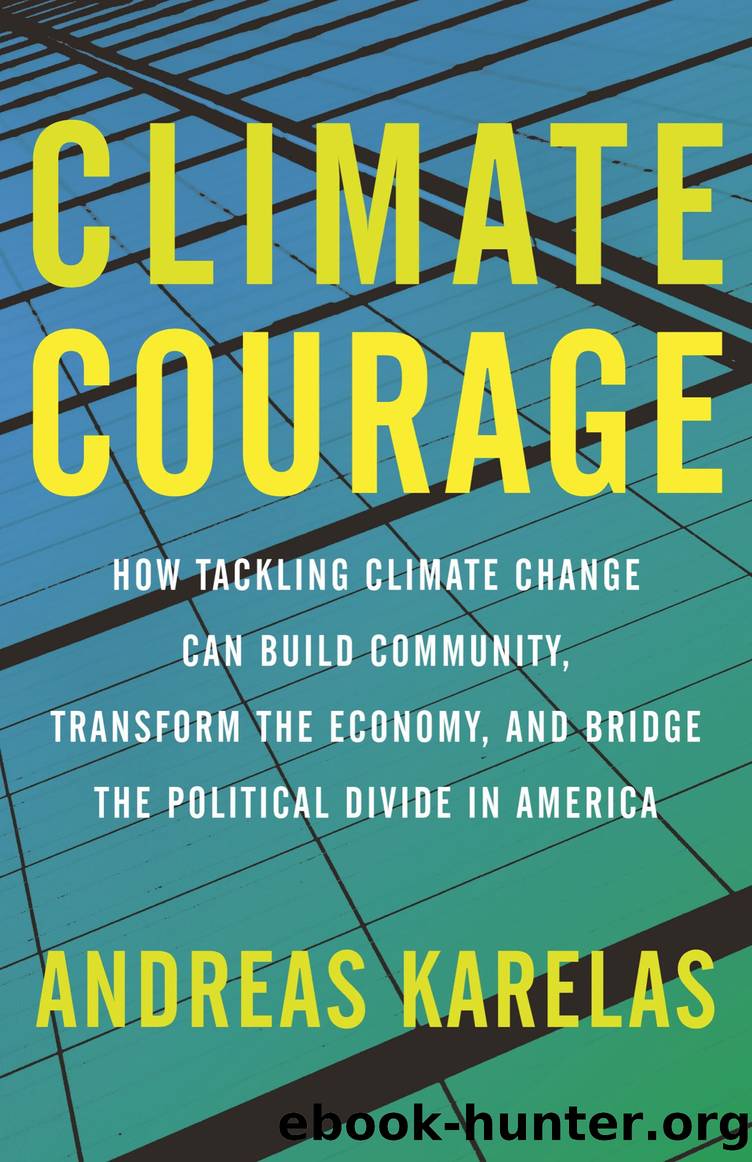
Author:Andreas Karelas & Katharine Hayhoe [Karelas, Andreas & Hayhoe, Katharine]
Language: eng
Format: epub
Publisher: Beacon Press
Whatâs great about organizations like Apple or Nike or the Yankees committing to sustainability is that their efforts go beyond the impact of reducing their footprint or even inspiring other organizations in their industry. The real game-changer is in the minds of the public. Think about all the Yankee fans who will be surprised to learn about their teamâs commitment to meeting the Paris Agreement goals, and how that might shape their own opinions on the UN climate accords. Or for all the athletes who wear Nike apparel and know that their gear was made using renewable energy. As opposed to sustainability being something thatâs foreign or fringe, when brands that we trust demonstrate that they want to do something about climate change, climate action becomes a familiar concept and, eventually, people see it as just the way things are done.
VIVA LAS VEGAS!
While the companies weâve already discussed have certainly gone above and beyond to demonstrate their commitment to sustainability, this next company had to claw its way through regulatory barriers to achieve energy independence.
As Iâm sure youâre aware, Las Vegas gets plenty of sun. And the hotels and casinos there use lots of electricity to keep their establishments open around the clock. In 2016, MGM Grand, owner of thirteen casinos and resorts along the strip, decided to invest in achieving energy independence rather than be subject to the increasing costs of their electric utility, NV Energy.22 They started by adorning the decadent Mandalay Bay Resort convention center with twenty-six thousand solar panels, making it the largest contiguous rooftop solar array in the country at the time.23 This array produces enough solar energy to power one thousand homes every year.24
But the astonishing 8.3 megawatt system still only covered 25 percent of the power MGM needed.25 To further achieve energy security, they had to build more solar offsite. This posed a problem to NV Energy, the regulated monopoly utility provider. In most parts of the country, you canât choose the company you buy your energy from. To keep the electric grid functioning smoothly, most states are regulated, meaning they only allow one major electric utility to provide energy for everyone in a certain area. The original idea behind the model was understandable: state governments didnât want different power companies building different grids connecting their own wires every which way and creating a veritable mess. Today, however, many states have successfully deregulated their electricity markets, allowing customers to choose among different electricity providers all through the same wires.
But in Las Vegas, MGM didnât have that option. And NV Energy didnât want to let them go, as MGMâs thirteen properties accounted for 7 percent of NV Energyâs electricity sales. The three-member Public Utility Commission that regulates NV Energy set the fee that MGM would have to pay to source its own energy at $126.5 million.26 The regulators justified the exit fee with an argument known in the industry as the âutility death spiral.â27 If one customer leaves the grid to go solar, then
Download
This site does not store any files on its server. We only index and link to content provided by other sites. Please contact the content providers to delete copyright contents if any and email us, we'll remove relevant links or contents immediately.
Man-made Catastrophes and Risk Information Concealment by Dmitry Chernov & Didier Sornette(6013)
The Revenge of Geography: What the Map Tells Us About Coming Conflicts and the Battle Against Fate by Kaplan Robert D(4077)
Zero Waste Home by Bea Johnson(3835)
COSMOS by Carl Sagan(3622)
Good by S. Walden(3549)
In a Sunburned Country by Bill Bryson(3538)
The Fate of Rome: Climate, Disease, and the End of an Empire (The Princeton History of the Ancient World) by Kyle Harper(3064)
A Wilder Time by William E. Glassley(2860)
Camino Island by John Grisham(2797)
Organic Mushroom Farming and Mycoremediation by Tradd Cotter(2690)
The Ogre by Doug Scott(2680)
Human Dynamics Research in Smart and Connected Communities by Shih-Lung Shaw & Daniel Sui(2500)
Energy Myths and Realities by Vaclav Smil(2490)
The Traveler's Gift by Andy Andrews(2460)
9781803241661-PYTHON FOR ARCGIS PRO by Unknown(2365)
Inside the Middle East by Avi Melamed(2353)
Birds of New Guinea by Pratt Thane K.; Beehler Bruce M.; Anderton John C(2254)
A History of Warfare by John Keegan(2240)
And the Band Played On by Randy Shilts(2202)
